
STEAM GROUP
The Little Ovens that Could C00K3D
STEAM GROUP
The Little Ovens that Could C00K3D
0
IN-GAME
0
ONLINE
Founded
29 January, 2016
ABOUT The Little Ovens that Could

Brief History of Successful Ovens

The First Crematoria
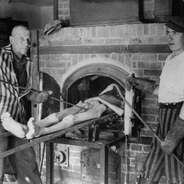
The first crematoria installed in the camps were oil fuelled Heinrich Kori single muffle mobile ovens and Topf & Sohne oil fuelled mobile double muffle ovens. These types of ovens had been in manufacture for a number of years and used in for example agriculture for burning debris, animal carcasses etc. They were relatively easy to produce and install. Mobile crematoria of these types were installed in Sachsenhausen (Kori) in 1940 and Dachau and (Topf) in 1940.
These ovens were not built for mass incinerations and as the body count in the camps grew after 1941 became totally inadequate. The camps looked for larger and more efficient capacity. They therefore asked Kori and Topf to design more permanent structures with greater capacity that could also use a less expensive fuel than the oil.
These companies designed cheaper and more cost effective ovens from the existing designs of the more expensive ovens used in the municipal crematoria.
Any semblance of a correct cremation as defined in law was designed out of the process to achieve maximum efficiency (speed to cremation) and lowest cost.
Permanent Crematoria
Thus Kori produced a permanent bricked in single muffle oven that used coal as fuel. Topf produced a a permanent bricked in double and then triple and eight muffle ovens using coal as fuel (they also had a design for a single muffle for which there is no evidence of one being installed in any of the camps). These were designed specifically for the concentration camp market.
In most camps the crematorium building was one of the few permanent brick built structures. So for example in Dachau, Sachsenhausen, structures were built that encompassed in a single building gassing and cremation facilities. The ultimate expression of this phase was the massive building program at Birkenau in 1942 and 1943 with four huge gas, cremation facilities capability of gassing and cremating thousands per day.
Typically the crematorium building was just outside the prisoner compound but not too far so as to allow easy access for the body gatherers.
These large permanent crematoria buildings also became the location of executions in the camp. In Mauthausen prisoners were shot in an ante chamber of the crematoria building. Similarly in Buchenwald there was a room in the crematorium building for hanging prisoners on hooks attached to the wall.
Facilities also existed in these buildings for dissecting bodies and removing gold teeth. The typical crematorium building also included a cellar or mortuary for storing bodies until they could be cremated.
Cremation in the Sub Camps
POPULAR DISCUSSIONS
VIEW ALL (4)
GROUP MEMBERS
Administrators
Members
0
IN-GAME
0
ONLINE
0 IN CHAT
Enter chat room
Founded
29 January, 2016